|
Effective, Real world, Race & Street Proven Parts & Accessories |


|

|
- Better cooling |
||

|
- Higher Flow |
||

|
$39.50 |
|
High Flow -Balanced Thermostat |
|
$39.95 |
|
High Flow -Balanced Thermostat |
|
|||||||||||
|
|
|
|||||||||
|
|||||||||||
Our unique proprietary Powerports™ of our Vented Balanced Thermostat performs several critical tasks. First it allows coolant to completely immerse the internal passages upon filling, and purges all air pockets from the system before the first start up. Once running, the vented Powerports™ allow a tiny flow of coolant to circulate during the initial warm up cycle, preventing hot spots from forming, micro boiling from being created and air pockets from being formed. It also pre-warms the coolant in the radiator to eliminate the thermal shock to the warmed block when the thermostat opens and a rush of cold water would otherwise enter the now fully warmed engine block and cylinder heads resulting in suddenly contracting parts and components. This hazard is eliminated, engine wear is reduced and engine life is increased. While warm up times might appear to be slightly longer on the gauge, the engine is warming more evenly and consistently.

The High Flow Balanced Sleeve thermostat works well with high flow water pumps and high revving engines which can prematurely "close" other thermostats under those conditions.
The High Flow Balanced Sleeve Thermostats open closer to the set point. The balanced design keeps from being forced closed by water pressure. Keeps engine cooler with consistent and accurate coolant flow.
Our unique vented bypass design allows for more consistent flow during warm-up for reduced hot spots, eliminates air pockets and prevents thermal shock when the thermostat opens!
This thermostat uses a "wax trigger" (yellow arrow), which is designed to melt at a predetermined point, thereby opening the thermostat at precisely the same temperature, every time. The 3-port construction (blue arrow) equalizes the water pressure from above the valve (radiator side) to the higher, pump pressure side. This allows the thermostat to open effortlessly and accurately no matter what the water flow, or engine RPM is at that particular time. Non-balanced designs are prone to be forced closed when the water flow abruptly increases, such as during sudden increases in engine RPM. Also, note the increased water flow capability (red arrow) of the Balanced model compared to the relatively smaller standard style thermostat.

Cooling system tips centering around the most overlooked component in the loop… the Thermostat: Any internal combustion engine incorporating a closed liquid coolant system, needs a thermostat. This not only regulates the temperature, but also the water flow during the open cycle of the thermostat. Too much flow can pass the water too quickly over the coolant jackets not absorbing maximum heat transfer. Too much flow prevents the coolant from spending enough time in the radiator to allow efficient liquid to air heat transfer. Too little flow can overheat the coolant before it gets a chance to radiate it's heat stored in it's mass. If coolant flows too fast as in the case of no thermostat being present, the coolant can leave air pockets in the nooks and crannies in the cylinder heads, thereby "superheating" into an expanding gas, which forces water out of the overflow even though the water leaving the engine appears to be well below it's boiling point.

This is a dangerous situation leading to serious engine damage due to cracked heads and cylinder blocks, without warning. Some reasons racers have deleted the thermostat in favor of calibrated water neck restrictors, is the goal to eliminate potential thermostat failures, as well as preventing conventional thermostats from being forced closed under high rpm water flow. Even though these concerns are genuine, they do in fact make 'racing' thermostats, called "Balanced Thermostats" which eliminate these concerns.
Standard thermostats can be off as far as 10 to 20 degrees, in regard to their stated opening and closing points. Balanced styles can be as accurate within a few degrees. Standard types are prone to failure, such as the one in the center. This results from the brass metal bridge over the plunger giving way, therefore closing the thermostat completely, restricting all water flow. Within minutes, total engine destruction is inevitable.
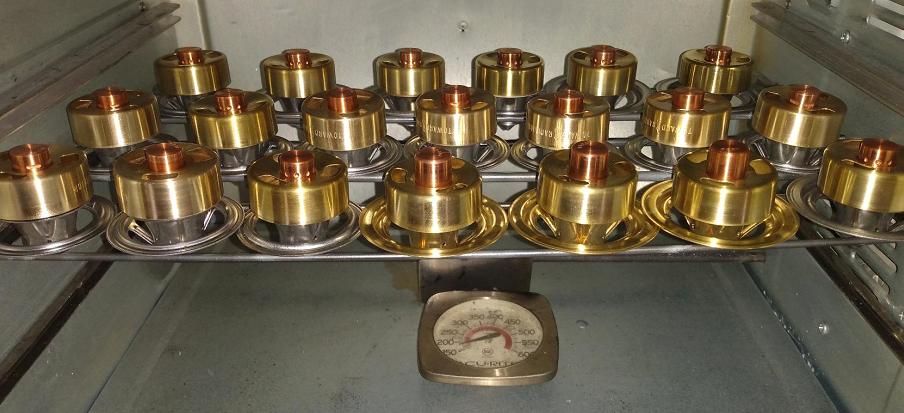
We thoroughly test each and every thermostat before packaging to ensure it will work perfectly right out of the box!
Tests prove that simply opening the thermostat precisely at the same temperature over and over again, the engine remains cooler on average. Engines can warm up faster to normal operating temperature, and cool down quicker once the engine exceeds the set point. This results in longer cylinder wear, and consequently longer engine life. By opening the thermostat 'on time', every time, the temperature swing is reduced, allowing for more complete cooling. By getting the thermostat open as quickly and as wide as possible, allows the warm water to exit quickly, thereby getting it to the radiator to begin it's cool down cycle as fast as possible. As a result, getting the cool water into the engine and holding it there, extracts as much heat from the engine as efficiently possible, therefore enabling to radiator to work at it's maximum potential as well. As you can see, there's a lot more to a thermostat than just 'making your gauge stop' at a certain point! This graph illustrates the importance of how critical optimum coolant temperature is to the longevity and performance of an internal combustion engine.

Cool water makes good horsepower, to a point. Warm water minimizes engine cylinder wear, to a point also. However, there is a "middle ground" where both optimum performance as well as minimal wear share similar characteristics. That "magic" number lies in the 175-180 degree range, which requires a 180 degree thermostat. The all too commonly used 160 degree thermostat is way too low to be considered for performance or engine longevity. As the chart illustrates, engine wear increased by double at 160, than at 185 degrees. So then, why do the 160's exist in the first place? The 160's were commonly used in older, open loop cooling systems where only 6 pound radiator caps were used, and low 212 degree boiling points were experienced. In contrast, modern cooling systems can see upwards of 260 degrees in coolant temperature with radiator pressures exceeding 45 pounds. Many early hot rodders found the 160's to be better performing than the 190's, however, the in between "180" appears to satisfy both ends of the spectrum. The correct water temperature is required for the cylinders to achieve a minimum specific temperature in order to allow a fully homogenized Air/Fuel mixture to combust efficiently.
Guess what the minimum number is… right! 180 degrees. Even so, you might see some still recommending the lower 160's, for no other reason than to possibly get that last drop of horsepower out, at the high price of dramatically reducing the life of the engine and it's internal components.

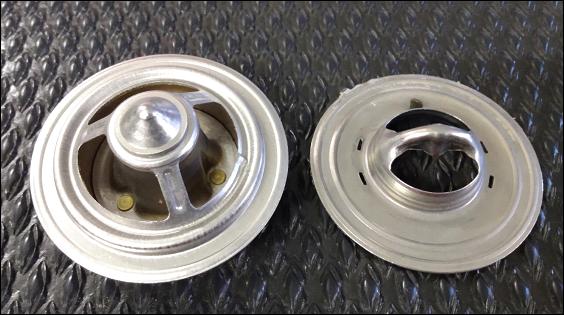
Notice the significantly increased flow area of the Balanced Thermostat (left) as compared to even a gutted out thermostat used as an open restrictor plate (right). That's almost 3 times the flow capacity! The balanced thermostat will flow more coolant when the engine needs it, and maintain the optimal operating when the engine is not making heat both consistently as well as bringing the engine up to operating temperature quicker reducing engine wear.