|
|
||
The valve train of an internal combustion engine is one of the most fragile components in the system, but when they are pushed beyond their mechanical limitations, the destruction that can result is phenomenal. The valve's only job is to allow air in and out of the cylinders, while containing the forces of the combustion process in between. The causes for valve train failure can result from several things. If spring pressures exceed the valve's metallurgical strength, or if the RPM exceeds the spring's ability to control the valve's motion, valve failure is imminent. As the illustration to the right shows, high performance valves can endure severe punishment and abuse while still retaining their integrity, strength and durability. The four valves show varying degrees of bend, still without breaking the valve itself, which would cause incredible destruction. As the rpm's become higher, spring loads greater, and valve strengths weaker, failure is undoubtedly inevitable.

This particular failure was caused by floating a valve, resulting from exceeding the rpm limitation of the valve train, thus tapping the piston against the valve at ultra-high speeds. Once the broken valve head had wedged itself between the piston and the cylinder head, the connecting rod compressed like an accordion in a Polka Parade. At 7,000 rpm's, the piston was hitting that broken valve at a rate of 116 times per second. Keeerunch!
Luckily, in this case, the valve head broke of, embedding itself into the piston top. The word "luckily" is used, because usually the broken valve pieces transfer from cylinder to cylinder, wreaking havoc on the entire engine. If the Intake valve fails, the open port allows the shattered debris to be sucked backed into the intake manifold from the suction of the other cylinders, and this process is repeated hundreds of times a second. The result is a catastrophic failure leaving very few clues behind.

When Valves fail, the piston and connecting rod is sure to follow. When an unstoppable force meets an immovable object, especially at high speeds, everything else around it pays the price as well. Pistons many times shatter into numerous pieces, which in turn, the close fitting camshaft breaks and typically takes out the engine block as a final encore.
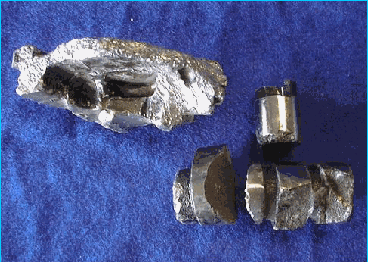
The illustration to the right shows a portion of a broken piston, lifter and camshaft. Not much more was discernable from the remains of this particular engine failure. The actual cause of this catastrophe was determined to be nothing more than a connecting rod failing after dropping a valve. Unfortunately this happened 600 miles into a break in of a new $6,000 engine, where the operator failed to readjust the valves after break in procedure, before taching up the engine past 7,000 for the first time. An expensive lesson.
Roller lifters can be a blessing from the devil, depending on how the game is played. Roller lifters were originally designed to alleviate side loads on the lifter when using high lift cams. They were an upgrade from flat tappet mechanical lifters. Soon after, the cam grinders took advantage of this benefit, and made the cams open faster, longer, and higher. Increased spring pressures were needed to control these radical valvetrain conditions, and even though the roller design could allow this situation, it still is just a mechanical device, now being pushed to it's limits.
In contrast, modern hydraulic roller camshafts are limited to their cam profile by the hydraulic feature of the lifter, and in these applications, the roller feature is for the most part unnecessary, and primarily intended just to reduce a slight amount of friction.
When roller lifters are pushed beyond their limits, the results of their failure is biblical in proportions. Ironically, most failures are NOT from over revving the engine...

Rollers, even oil pressure fed versions, get their primary lubrication from the slinging crankshaft. At lower engine speeds and idling, this oil spray does not effectively exist. With the ultra high spring pressures (900lbs open) required to keep high revving, fast-ramp camshafts from floating, the rollers can simply beat themselves apart on the street. In racing application and high rpm applications, the failures using this same combination are reduced dramatically.
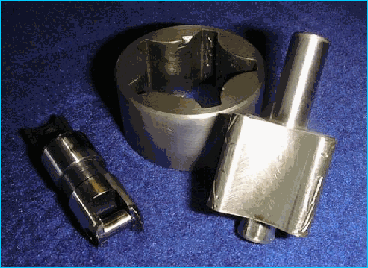
Shown in the illustration above, the roller lifter has completely ground the roller off, all the needle bearings and even ground half way through the roller trunion. The free-borne needles floating in the oil system found their way into the oil pump, where the hardened needle bearings embedded into the also hardened oil pump gears. If it were not for the H.D. oil pump drive shaft, oil pressure would have been lost immediately, thus causing instant and complete engine failure. The standard oil filter caught everyone of the needles before the could spread to the rest of the engine.